








Rollator Guide: Which Rollator Should I Choose?
If you're in the market for a new rollator, there are quite a few things to consider. Here's a handy, easy-to-follow guide to help you find the perfect rollator to meet your needs.

Should your rollator be for indoor or outdoor use?
Rollators can generally be divided into three categories: indoor, outdoor and combination rollators, which are suitable for both purposes.
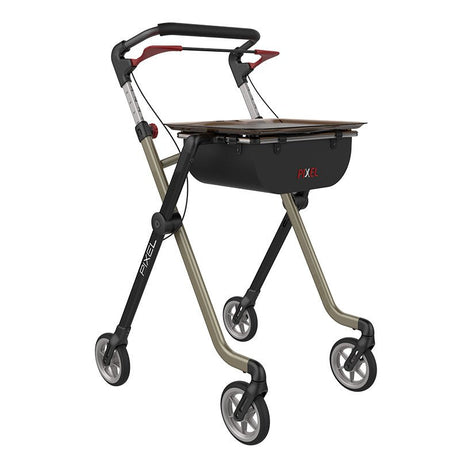
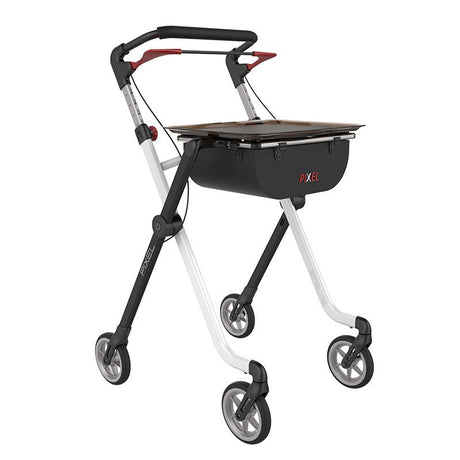
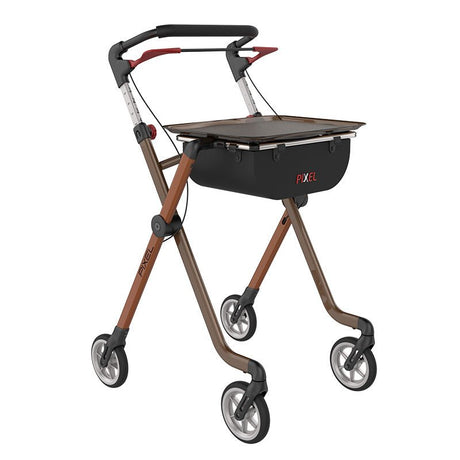
- AN INDOOR ROLLATOR is, as the name suggests, designed for indoor use. It is narrower and fitted with smaller wheels, making it easier to manoeuvre around the home. An indoor rollator typically comes with a tray that can be used for meals, as well as a small basket for carrying essential items such as reading glasses and keys. An indoor rollator is not suitable for outdoor use.
- AN OUTDOOR ROLLATOR is more stable and has larger, softer wheels, making it easier to handle forest paths, cobblestones and other uneven outdoor terrain. Extra-soft or pneumatic tyres can also be an advantage, as they provide shock absorption. Outdoor rollators are usually equipped with a seat, allowing you to take a break whenever you need one. You can also use an outdoor rollator indoors, provided there is enough space.
- A COMBINATION ROLLATOR is essentially the same as an outdoor rollator, since all outdoor rollators can naturally also be used indoors. However, you should always make sure that the rollator you choose is not too wide for the door frames in your home. This will rarely be an issue, but it can happen if, for example, you live in an older farmhouse. Please note that only outdoor rollators can also be used indoors. Indoor rollators, on the other hand, are not suitable for outdoor use due to their more lightweight design.
Whether you are looking for an indoor rollator or an outdoor/combination rollator, you will find it at Seniorshop.

Weight: What should your rollator weigh?
The weight of rollators varies from around 13 kg down to as light as 5 kg. Generally, lighter rollators are more expensive because they need to be manufactured in a way that keeps them just as strong and stable as heavier models.
Weight is crucial if you need to lift your rollator up stairs, into a car, or even over a curb.
A lightweight rollator is much easier to manage in daily life and is especially practical if you find yourself lacking in strength.
Which are the most lightweight options?
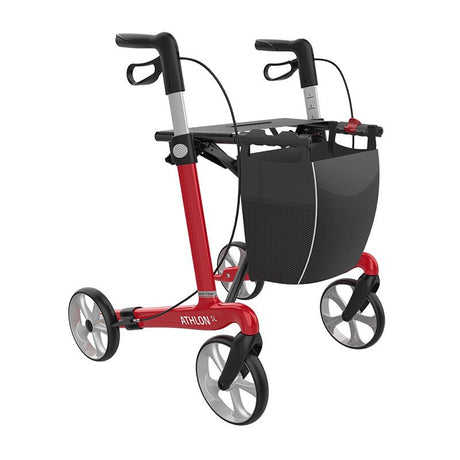
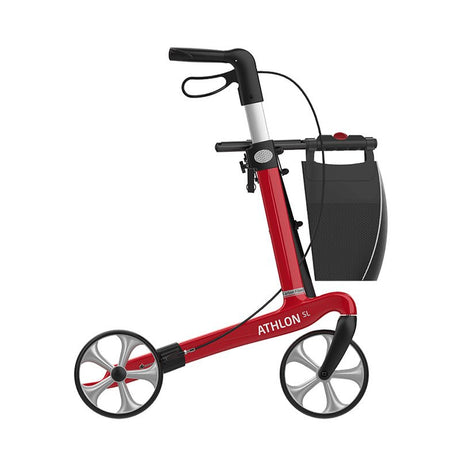
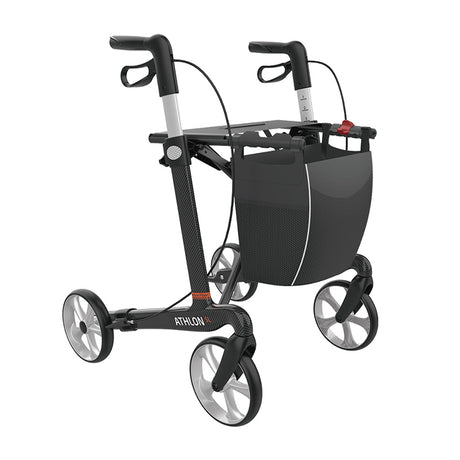
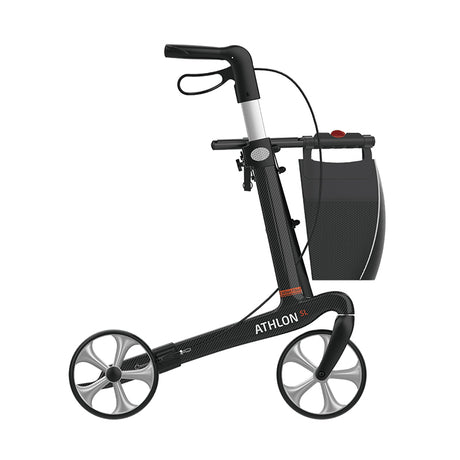
At Seniorshop, we offer many lightweight outdoor rollators. Our lightest model is the Athlon SL rollator, which weighs just 5.2 kg.
The Athlon is available in black and red.

Collapsibility
All the rollators we offer at Seniorshop can be folded to take up significantly less space. However, the folding mechanism varies among them.
There are two methods, illustrated below.
Method one (1) is a “vertical folding” technique. Here, the front part of the rollator folds into the back. The downside of this method is that the rollator cannot stand on its own once folded, and you'll need to remove any baskets or trays before folding.
Method two (2), which most of our models use, is a “horizontal folding” style. This method folds the sides together much like an accordion. The advantage here is that the rollator can stand on its own when folded, and there's no need to remove the basket or seat, as they are designed to fold along with the rollator.

Do you have questions?
We hope you're feeling confident in finding the perfect rollator for you. If you have any questions at all, please don't hesitate to reach out to our helpful and experienced customer service team.
Rollators
View all-

 Best for the price
Jazz rollator - Practical and Safe
See more2 835,00 krUnit price /Unavailable -

 Best for the priceSee more2 984,00 krUnit price /Unavailable
 -

 See more1 339,00 krUnit price /Unavailable
 -
 Exclusive product
Athlon SL Rollator *SUPER LIGHT* – Red
See moreFrom 4 934,00 krUnit price /Unavailable -
 Exclusive product
Athlon SL Rollator *SUPER LIGHT* - Black
See moreFrom 4 934,00 krUnit price /Unavailable -

 Exclusive product
Athlon SL rollator *Size large* - Gray
See moreFrom 4 934,00 krUnit price /Unavailable -
 See moreFrom 2 984,00 krUnit price /Unavailable
 -


Jaguar Supreme indoor rollator
See more2 536,00 krUnit price /Unavailable -
 See moreFrom 2 984,00 krUnit price /Unavailable
 -
 See more2 984,00 krUnit price /Unavailable


