
By private nurse Anette Kjær Seidler
“My legs feel like lead ...”
As a private nurse, I’ve heard that many times!
Do your legs, ankles or feet ever feel heavy, tight or swollen as the day goes on? Many older adults experience what we in nursing call dependent edema—a clinical term for fluid that collects in the lowest parts of the body (typically the legs).
Heavy legs aren’t just a sign of getting older. They can also mean your circulation needs a little help working against gravity—whatever your age.
Why does fluid build up in the legs?
Most of us have probably experienced fluid building up in our legs—during pregnancy, after sitting or standing at work, on long journeys or during hot summer days. But as we get older, our bodies change, and our circulation may not work quite as well. The three most common causes of fluid in the legs are:
- Gravity: Blood has to travel all the way from your feet back up to your heart. If your circulation is a little sluggish, fluid “settles” downward.
- Weaker vein valves: Our veins have small “valves” that stop blood from flowing backward. When these valves become worn, fluid can build up in the legs.
- Inactivity: When we sit or stand still for a long time, our calf muscles can’t do their usual job as a “pump” to push blood upward.
What can you do about heavy, swollen legs?
Here are some simple things you can do in your everyday life to help ease fluid buildup in your legs:
- Put your legs up: Rest your legs on a footstool or cushion when you’re sitting on the sofa or in an armchair. Try to raise your feet slightly above heart level so gravity can help fluid drain away.
- Keep moving: Take short walks or do simple exercises while sitting, such as flexing your feet and rotating your ankles. This gets your calf-muscle pump working.
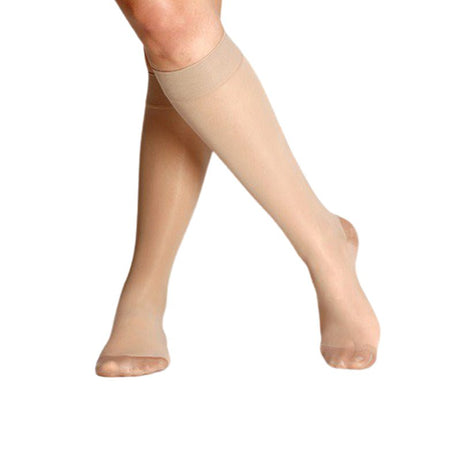
- Wear compression stockings: Compression stockings apply firm, even pressure around the ankle and help your circulation move fluid back up the legs.
- Avoid tight clothing: Make sure your socks and trousers aren’t tight around your ankles or calves, as this can restrict blood flow.
Although dependent edema is often harmless and commonly caused by ordinary circulatory fatigue, I always recommend contacting your doctor if:
- The swelling is only in one leg (especially if it’s painful, red or warm).
- You suddenly become short of breath or feel unusually tired.
- The skin on your leg feels so tight that it looks shiny or starts to weep fluid.
How to support circulation in your legs
For people dealing with dependent edema, compression stockings are one of the most effective options. That said, choosing the right type is very important: too little pressure won’t help, while too much can be uncomfortable or even unsuitable for your circulation. Always seek professional advice before choosing and wearing compression stockings.
So the next time you put your feet up on the sofa with the TV on, you can tell yourself (and anyone around you) that you’re not just relaxing—you’re giving your legs some serious medical prevention.