What are compression socks?
Compression socks provide compression around the feet and legs. Many compression socks feature graduated compression, with the greatest pressure around the ankle gradually decreasing up the leg. This supports the return of blood through the veins and may help reduce swelling, soreness and the feeling of tired or heavy legs.
Compression socks are used by people who spend a lot of time standing or sitting, experience swollen or tired legs, or want extra support during longer journeys. They are available in different lengths, sizes and compression levels, so it is important to choose socks based on both your intended use and individual needs.
What do compression socks help with?
Compression socks are often associated with older adults, but they are used by both younger and older people, men and women. They may be beneficial after prolonged periods of sitting or standing, during travel, or if you are prone to swollen and tired legs.
Graduated compression socks may help to:
- Support blood circulation: Compression helps the veins return blood from the legs.
- Reduce swelling: Pressure around the legs may help limit fluid retention and swelling in the legs and ankles.
- Relieve tired and heavy legs: The support may reduce feelings of soreness, fatigue and heaviness after, for example, a long day spent standing or sitting.
- Help with varicose veins: Compression socks may be used to relieve symptoms such as swelling and pain associated with varicose veins.
- Provide support during long journeys: Graduated compression socks may be useful during longer flights and car, bus or train journeys, when you remain seated for many hours.
When may compression socks be useful?
Compression socks may be useful if you, for example:
- stand or sit for extended periods
- experience tired, heavy or swollen legs
- are going on a longer flight or car, bus or train journey
- experience swelling in your legs during pregnancy
- have varicose veins or related discomfort.
It is important to choose the correct size and compression level. If you have a disease or condition that affects blood circulation – particularly the arterial blood supply to the legs – you should seek medical advice before using compression socks.
Compression socks for flights and travel
Compression socks are often used as flight socks or travel socks, because prolonged sitting during travel can cause swollen and tired legs. When you sit still for several hours, the calf muscles work less, which can affect the return of blood from the legs.
Long journeys with limited movement are also associated with an increased risk of deep vein thrombosis (DVT), also known as a blood clot in a deep vein. However, the risk is generally low for people without other risk factors.
Movement remains important during travel. On longer journeys, it can be beneficial to stand up and walk regularly when possible, as well as move your ankles and calf muscles while seated.
People at increased risk of blood clots may in some cases benefit from graduated compression socks during longer journeys. If you have previously had a blood clot or have other known risk factors, you should speak to your doctor about which precautions are appropriate for you.
What does graduated compression mean?
With graduated compression, the pressure is not the same throughout the leg. Compression is strongest at the bottom and gradually decreases further up the leg. The aim is to support venous blood circulation from the legs back towards the heart.
Compression strength is typically measured in mmHg (millimetres of mercury). Therefore, it is a good idea to check both the size and stated compression when comparing compression socks.
Our range includes compression socks with class 1 compression of approximately 15-20/21 mmHg. Always check the specifications for the individual model, as compression, fit and materials vary.
Compression socks for men and women
Compression socks can be worn by both men and women. Some models are sold as men's or women's styles, partly because of differences in sizing, fit and design.
The most important thing is to choose a size and fit that suits you. A compression sock should fit snugly to provide the intended compression, while also fitting correctly around the leg.
At Seniorshop, you will find both classic and more colourful compression socks in a variety of sizes and designs.
Compression socks from Sockwell
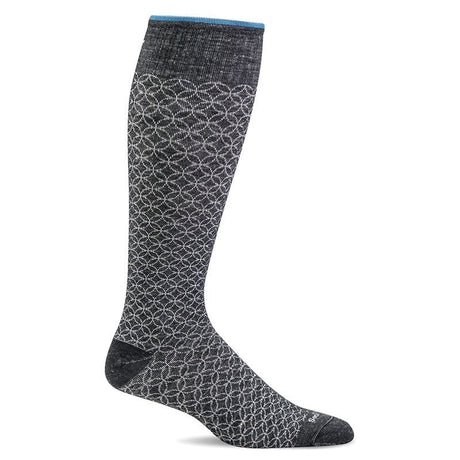
Our selection includes compression socks from Sockwell, combining graduated compression with a range of colours and patterns.
Several of our Sockwell models offer class 1 compression of 15-20 mmHg and are made from a blend that includes merino wool, bamboo, nylon and spandex. The exact material composition and compression level depend on the model, so always check the specifications for the individual product.
Sockwell states that its socks are made in the USA using American merino wool. The manufacturer also works with recycled nylon, recyclable packaging and initiatives intended to reduce the environmental impact of production.
How to choose compression socks
When choosing compression socks, it is especially relevant to consider the compression level, size, length, material and intended use. For example, your needs may differ depending on whether the socks are for everyday wear, work or a longer journey.
Check the specifications for each pair of compression socks for information about compression, sizes, materials and washing, so you can find the model that best suits your needs.

 Up to 15% off
 Up to 19% off
 Up to 19% off
 Up to 28% off
 Up to 19% off

 Extra wide fitUp to 19% off
 Up to 28% off
 Up to 19% off
 Up to 19% off
 Up to 12% off
 Up to 16% off
 Additional widthUp to 19% off
 Extra calf widthUp to 19% off
 Up to 19% off
 Sold out


